Automatic Content Recognition (ACR): How It Works & Why It Matters
Every time you use a smart TV or any other streaming platform, you will see that after a few searches, the algorithm will automatically show you related content as on your interests. This is Automatic Content Recognition (ACR) that is not limited only to the TV, this works on every large platform to generate more profits.
So, let’s understand how this automatic content recognition works and what the different types of ACR technology are available. Most importantly, if you are a user or advertiser, you can know what the challenges and future use cases of it.
What is Automatic Content Recognition?
Automatic Content Recognition (ACR) is a modern technology used by almost every smart TV and streaming platform (Netflix, Amazon Prime, etc.). This technology can automatically analyze what you want to “hear” or “see” while using any application.
Saying this can’t be wrong, that Automatic Content Recognition is a win-win situation for everyone. Advertisers can make more by showing their ads to relevant customers, and customers are also happy because they will see what they want to see.
This technology runs in the background, silently analyzing your view time, your songs, your interests, etc.
How ACR Works
The working process of Automatic Content Recognition can be divided into 4 steps. Lets see
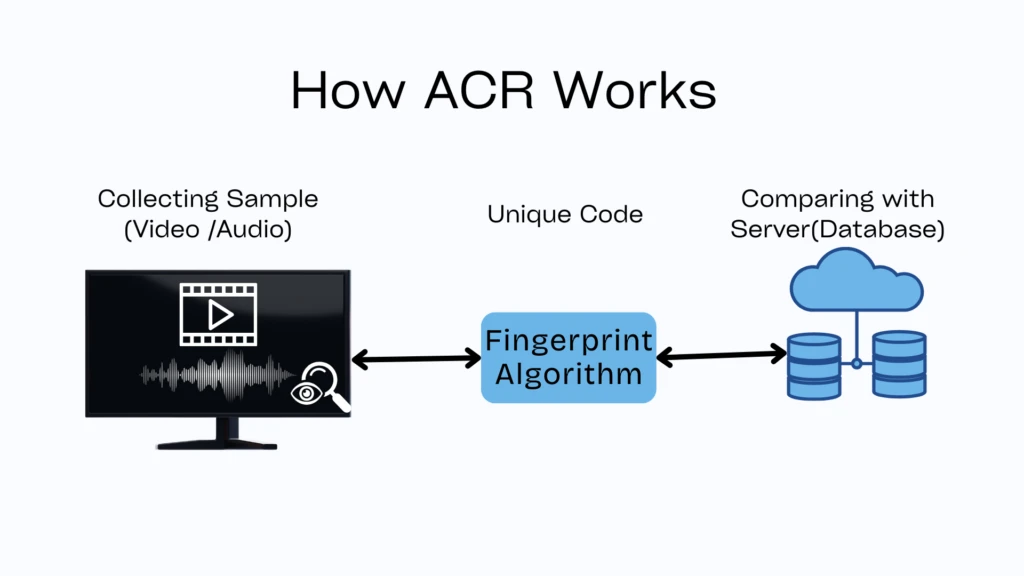
First, the device(SmartTV, Mobile, or Laptop) regularly captures a snippet sample of what’s playing. This could be a few seconds of audio and/or a few video frames.
Second, these recorded samples(audio or video) will be converted into a compact digital signature. After that, it analyzes the frequency patterns or visual textures of that sample and creates a unique hash code(fingerprint).
Third, these fingerprints are sent to the server, and it compares the sample’s signature with its database.
If the sample matches an entry, the server identifies the exact piece of media and sends back metadata. This might include the title, episode, broadcast time, advertiser info, or other related content.
If not, then it compares more fingerprints again and again and comes up with a relevant video suggestion.
This whole cycle – sample, fingerprint, match, respond – happens very quickly and repeatedly as you watch or listen. Modern ACR systems are much faster, efficient, and accurate.
What Are the Main Types of ACR?
There are mainly 3 types of ACR available.
1. Audio (Acoustic) Fingerprinting
In this, the audio is used to find out what you are listening to. This method analyzes the sound characteristics like frequency, tempo, and spectrum to create a fingerprint of the audio clip. This is mostly used by music channels.
The best part about audio fingerprinting is that it uses format- and codec-independent, so it works even if the content has been compressed or encoded in different ways.
2. Video Fingerprinting
For visual content, small clips of video are extracted, such as edges, colors, and motion patterns. The video fingerprinting algorithm is designed to be resilient to transformations. It still works if the video is scaled, compressed, or altered slightly.
Video fingerprinting allows devices to identify content purely from its image, without relying on sound.
3. Digital Watermarking
Digital watermarking embeds information directly into the media file during production or broadcast. This is a small, invisible, or inaudible code (a “watermark”) that is inserted into the audio or video file.
Smart TVs and other devices have specialized decoders that can detect these watermarks when the content is played. For example, a TV broadcast might quietly insert a watermark every few seconds that encodes the channel ID, program ID, and time stamp.
Because the watermark is part of the signal itself, it doesn’t depend on content fingerprints.
All of these ACR methods are really helpful for users and advertisers both. Also, Many systems use a combination of these techniques to maximize accuracy.
Real-Life Use Cases of Automatic Content Recognition
ACR is behind many of the interactive and data-driven features we see in media today. Its main applications include:
Smart TVs and Second-Screen Apps:
Nearly all modern smart TVs come with built-in ACR. They continuously monitor what’s on screen and send data back to manufacturers or partners. This enables features like syncing a smartphone or tablet app to the TV show you’re watching, or interactive overlays.
Targeted Advertising and Audience Measurement:
Advertisers and networks heavily rely on ACR data. Because ACR gives you user information and their interest, that helps them to target your audience more precisely. They can also measure how many people watched their ads.
With ACR data, streaming platforms can also learn viewing patterns in real time and suggest new shows.
Music and Media Identification:
Music streaming platforms like Spotify, Shazam, and SoundHound also use Automatic Content Recognition to identify the test of your music. They use acoustic fingerprinting of audio captured by the microphone.
Piracy and Copyright Monitoring:
ACR is the best way to find who is using your original video. If we talked about platforms like YouTube, it uses watermark fingerprint to find copyrighted songs, video clips, or commercials. ACR helps to protect the use of any clip or audio file without its permission. The owner has the right to give copyright strikes that can impact your account or monetization.
I’m sure that these use cases will help you to understand the importance of ACR in the online world. ACR is a win-win situation for users and advertisers.
What could be a possible drawback of ACR?
ACR is a great technology developed by engineers, but it also has multiple disadvantages.
This is collecting huge amounts of user data without their permission. Many people worry about what data is collected, how it’s used, and who it’s shared with. Your data is collected and stored in a database with a unique fingerprint.
Sometimes, ACR data may be inaccurate due to blurred lines, glitches in the network, background noise, or altered video. This may impact the reach of the ad.
Another risk is the security of data. If the attackers spoof fingerprints or watermarks, then it creates measure issues
In short, the ACR dataset also requires careful handling of privacy, accuracy, and ethics.
Conclusion
Finally, Automatic Content Recognition is a great technology used by advertisers and TV channel companies. This technology is reshaping how we consume digital media. This is a great option for business, consumers, and content creators. Advertisers can leverage data to generate more profits, whereas consumers will see only relevant ads. Creator can also protect their original media from misuse.
Frequently Asked Questions
1. What are the future trends of ACR technology?
AI and machine learning are making ACR smarter and more accurate. Not only a TV channel, this technology will also be used in new media formats like 360° videos, VR videos, & holograms, etc. ACR will soon recognize live content and run on-device with the help of 5G and edge computing.
2. Where is ACR commonly used?
Automatic Content Recognition (ACR) is commonly used by smart TVs, music streaming apps, video platforms, second-screen apps, advertising platforms, and even broadcast monitoring systems.
3. How is ACR useful for creators and artists?
ACR is a great way to add a watermark fingerprint to any media file. Everytime if somebody uses a part of your media without your permission, you have the right to file a copyright case. If it is on YouTube, it counts as a penalty.
4. Does ACR work offline?
Yes, some ACR systems (like ACRCloud) can work offline by storing a small database locally. But most require an internet connection to access large fingerprint libraries in the cloud for accurate matching.