PNG vs JPG for Website: Which One Should You Use?

PNG vs JPG is the most common debate when it comes to the use of images on websites. Choosing an optimal format of image affects quality, speed, and SEO. PNG and JPEG are the two most common formats used by websites. As per data, around 80% of websites use PNG and 76% use JPEG.
Here, we are going to compare PNG and JPEG in detail. This includes image compression, quality, transparency, SEO impact, loading performance, and compatibility. We will also touch down on newer formats like WebP and AVIF.
What is JPEG?
JPEG (Joint Photographic Experts Group) is a default image format in Windows, digital photography, web images, and mobile devices. This image format comes with a lossy compression that reduces the file size while maintaining decent visual quality.
JPEG files work on a Discrete Cosine Transform (DCT) algorithm. This algorithm analyzes the image and finds areas with similar colors or tones, then merges those pixels together to reduce the amount of data needed.
Example: A JPEG file can shrink down a 20MB image into a 2MB image without losing its visual appearance.
What is PNG?
PNG (Portable Network Graphics) is a first choice for web graphics, screenshots, and images that require editing. This works on a popular lossless image format. This means it preserves the full quality of your image, no matter how many times it’s edited or saved.
PNG format was developed as a more advanced and open alternative to the older GIF format. This uses a form of the LZW (Lempel-Ziv-Welch) compression algorithm, which understands repeated patterns (or “strings”) in the image data and replaces them with short codes stored in a dictionary inside the file.
PNG Vs JPEG Image Formats: Key Differences
The two most common image formats are PNG (Portable Network Graphics) and JPEG (Joint Photographic Experts Group). Let’s compare
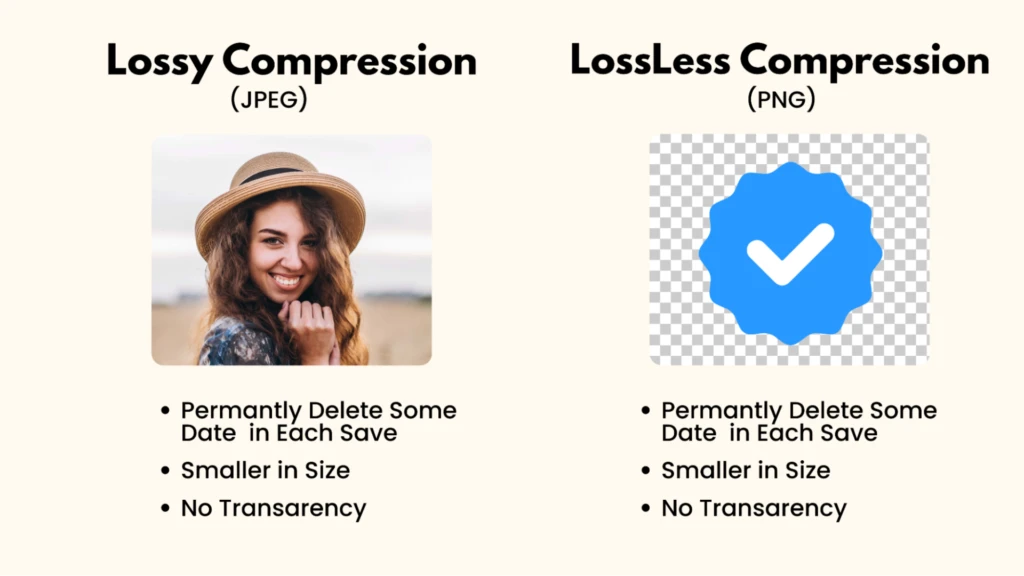
Lossless vs. lossy compression
A PNG format of images uses lossless compression (DEFLATE). This means image data will not be discarded during compression. No matter where you use this PNG image, each pixel of the PNG image will be preserved exactly.
In contrast, JPEG uses lossy compression (DCT-based) that discards some image data. This is the best option for photographers to share a much smaller file size.
A highly compressed JPEG file will show blocking or blurring artifacts around high-contrast edges. Over many edits or saves, a JPEG image can lose its quality, but a PNG remains sharp each time.
Transparency
PNG natively supports full 8-bit alpha transparency, which means the image can be fully transparent, partially transparent (faded), or fully opaque. You can blend a PNG image seamlessly into different background colors.
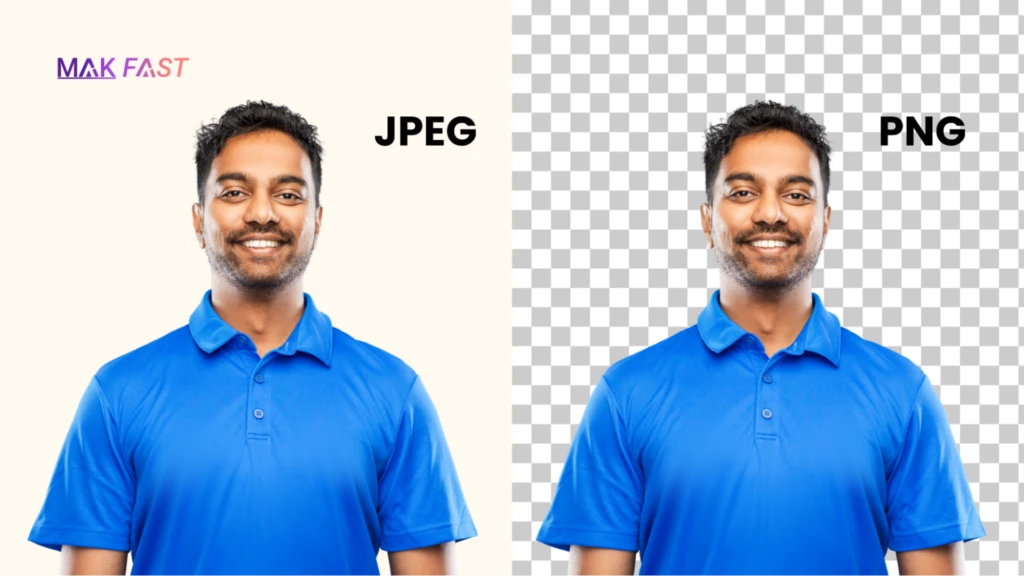
But the JPEG format does not support transparency, which makes it unsuitable for layered designs.
A transparent image is the best option to design graphics, logos, icons, overlays, buttons, and any image. Want to use multiple layers on a solid background, must use the PNG format (or another format) over JPEG.
File Extension
JPEG images are represented with a .jpg or .jpeg extension. Both extensions have the same functionality. The .jpg extension became common in early Windows systems that required 3-letter file extensions.
Whereas, PNG images are represented with a .png extension. This image format is working smoothly across all operating systems and devices.
PNG vs JPG: SEO Implications
Search Engine Optimization(SEO) does not give too much value to image format. But smartly using different image formats can help in better SEO. Google explicitly supports PNG and JPEG (as well as WebP, GIF, SVG, AVIF, etc.) in images it crawls.
Metadata:
JPEGs support extensive metadata (EXIF/IPTC/XMP) by default, which is useful in photography and publishing. The extensive metadata includes detailed image information (e.g., camera settings, copyright info.
Whereas PNG uses ancillary “text” chunks to store information like the author, description, or copyright. Text chunks include formats like tEXt, iTXt, and zTXt chunks. This is enough while working with web graphics or images.
Google’s Image Search primarily reads the page text and alt tag from the images. If a creator wants to license an image, then Google advises adding IPTC or structured data to it. For example, photo news sites or image sellers might use IPTC tags to credit photographers.
Page speed
Website page speed is a ranking factor on Google and other search engines. As we know, a website has lots of information, and a larger image size can affect its speed too. In one study of a WordPress blog, just switching header images from PNG to JPEG cut load time in half.
An image sitemap or alt text won’t save a page dominated by uncompressed PNGs. If you replace large PNG photos with high-quality JPEGs (or WebP), websites load much faster.
Google’s algorithms always support faster sites, and studies show even small delays can hurt user engagement. So, it’s important to compress your image size for better ranking.
Note: Google supports both the files; it’s just a speed issue.
Loading Speed and File Size
File size format greatly affects load time. JPEG’s lossy compression can compress an image into much smaller files than PNG for the same photo.
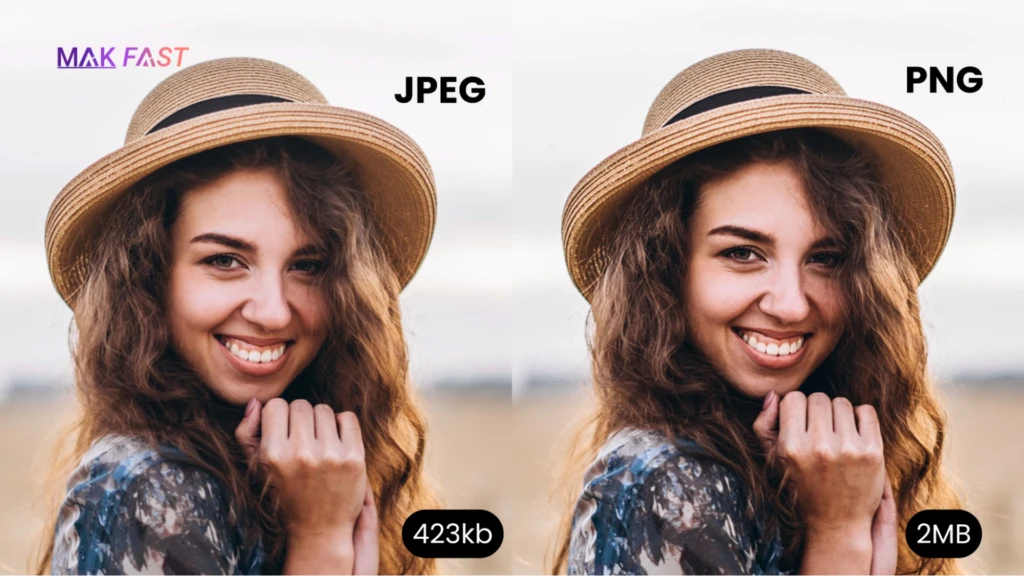
For example, as per searchenginejournal, one benchmark tested a sample photo converted into various formats; the PNG was 552 KB, whereas the equivalent JPEG was only 91.5 KB.
On a slow 3G connection, that difference translates to 9.16 seconds for PNG vs 2.91 seconds for JPEG.
As per Elementor, choosing the right image format can cut a photography site’s load time from 6.2 seconds to 1.8 seconds. Faster images directly help a website load faster.
So, in a mobile or poor connection, PNG images will load must more slower than JPEG and WebP files. Even on desktop, the larger PNG files are taking more time to load.
PNG vs JPG Compatibility in Browsers, Tools & Devices
Both PNG and JPEG enjoy universal support.
Web Browser & Mobile Devices
PNG and JPEG files are compatible with every modern browser and mobile device, including Chrome, Safari, Firefox, Edge, Opera, IE9+, Android, iOS, etc. Google crawler supports BMP, GIF, JPEG, PNG, WebP, AVIF, and SVG images, which means your image will be indexed.
Browsers and bots will pick the best one they support. For example, Googlebot will always crawl the image URL in the src attribute, so having a fallback <img> tag with a JPEG or PNG ensures the image gets indexed.
Editing:
Both formats can easily run on all major image editor tool including Adobe Photoshop, canva, GIMP, Affinity Photo, Microsoft paint, etc. JPEG’s color profile support means you can adjust quality or chroma subsampling in any software.
PNG support is also broad – it was created as a patent-free successor to GIF. An Adobe guide notes that JPEG images are viewable and editable across a vast array of operating systems and programs” without special software.
Printing:
PNG image’s lossless compression will give you higher-quality prints than JPEG files. PNG format is larger, but offers sharper lines and perfectly crisp text.
JPEG’s lossy compression reduces the quality of the image during printing. Use this image while printing photography images with a solid background.
PNG vs JPEG Quick Comparison
Let’s understand the difference with a simple table
| Feature | PNG | JPEG |
| Compression Type | Lossless (DEFLATE) | Lossy(DCT-Based) |
| Quality/artifacts | Original detail preserved and no block artifacts | Discards some data: Show blocking or blurring at high compression |
| Transparency | partial transparency possible | No native transparency |
| Common uses | Graphics with text or sharp lines | Photographs and complex images with continuous tones |
| File Size | Larger and Maintained | Generally smaller and discard Data |
| Editing Tolerance | Re-saved without quality loss | Quality degrades with each |
| File Extension | .jpg or .jpeg | .png |
| Loading Speed | Take More Time | Faster |
Different Use Cases Of PNG and JPEG
Both formats are ideal for different uses.
- E-commerce: JPEGs are perfect for product photos to reduce load. Most of the online stores and platforms recommend JPEG for photos and PNG for logos or graphical elements.
- Blogs/News: Sites with rich photography typically use JPEG (or next-gen) to minimize weight, whereas diagrams or text-rich graphics use PNG or SVG.
- Portfolios: Photographers should go for high-quality JPEG images over PNG.
PNG is a great format for graphics with sharp lines, text, or charts, whereas JPEG excels for photographs or complex images with smooth gradients. It can greatly reduce size while preserving an acceptable level of detail.
Modern Alternatives: WebP and AVIF
Until we had discussed PNG and JPEG in detail. But it’s also important to understand newer image formats like WebP and AVIF. Google’s WebP and the AV1-based AVIF format are much smaller files at better quality.
For example, in a compression test, WebP produced a 41 KB file vs 91.5 KB for JPEG, and PNG was 552 KB. A practical comparison with the Squoosh tool shows that an AVIF file can be 65% smaller than a JPEG at the same visual quality.
Conclusion
In the fight between PNG vs JPG for a website, there is no clear winner for the website. But using a high-quality JPEG is a better option than PNG. Whether you are using a PNG or JPG image format, make sure to add meaningful “alt” text with stable image quality. There are also newer formal options available with better quality at a smaller size. Understanding of this format can make your website fast, user-friendly, and SEO-optimized.